Medical Affairs : PLS Strategy
Plain Language Summaries for Clinical Research: A Practical Guide for Medical Affairs Teams
A practical guide to PLS structure, reading level, visual design, regulatory requirements, and validation — for Medical Affairs teams meeting growing demand for accessible research communication.
Executive Summary (TL;DR)
The Mandate: EU CTR, major journals, and patient advocacy expectations now require Plain Language Summaries for clinical research — and the standard for what counts as "plain language" is rising.
The Strategy: Defensible PLS production combines target reading level (typically Year 6–8), structured content following established frameworks, visual design rooted in health literacy principles, and patient validation before publication.
The Imperative: Brands that build PLS capability deliver the accessibility regulators and patients now expect; brands that treat PLS as an afterthought produce summaries that fail readability standards and erode trust.
OneAlphaMed Research Desk
Pharma & Life Sciences Practice • Brand Strategy Intelligence
Updated:May 12, 2026
7 min read
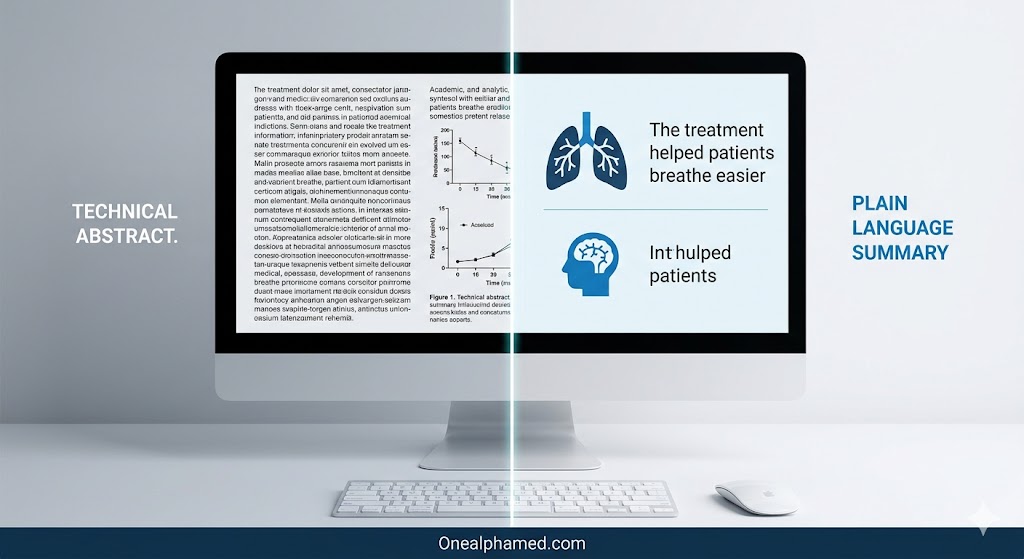
Fig 1. Plain Language Summaries translate clinical research into accessible language patients and the public can actually use
In this article:
- 1. What PLS Are and Why They Matter
- 3. Structure and Reading Level Standards
- 5. Validation and Quality Assurance
A pharmaceutical Medical Affairs team prepares to publish a major Phase 3 result. The journal accepts the manuscript. The submission package now requires a Plain Language Summary — a 250-word patient-accessible version of the abstract. The team drafts what feels like a simplified version of the academic abstract, runs it through internal review, and submits. Three months later, a patient advocacy group critiques the summary on social media: too technical, too long, too dense, and inaccessible to the patients the research is meant to serve. The brand’s accessibility credibility takes a hit it did not see coming.
This is the gap Plain Language Summaries (PLS) are meant to close, and the gap that poorly executed PLS create instead. Done well, PLS make clinical research findings genuinely accessible to patients, caregivers, and the lay public — meeting regulatory expectations, journal requirements, and the rising patient-engagement standard. Done poorly, they sit at a reading level no actual patient can engage with, and reinforce the perception that pharmaceutical communication is inaccessible by design. This guide covers what makes PLS effective, what regulators and journals now require, and the production discipline Medical Affairs teams need to deliver them.
1. What Plain Language Summaries Are and Why They Matter
A Plain Language Summary is a concise, accessible version of a clinical research publication written for patients, caregivers, and the general public — not for clinicians or researchers. The format typically runs 250 to 500 words for journal publications and may extend to longer multi-page formats for clinical trial result postings under regulations such as the EU Clinical Trials Regulation.
PLS exist for three converging reasons. Patients and caregivers increasingly want to access the research that affects their treatment decisions — not summarised by clinicians or media, but in primary form they can read and consider. Regulatory authorities have mandated PLS for trial result postings as part of broader transparency frameworks. Major medical journals — including BMJ, The Lancet, NEJM, and many others — now request or require PLS as part of submission packages. The accessibility expectation that started with patient advocacy has become operational requirement.
The discipline is harder than it looks. A PLS is not a simplified abstract, not a marketing summary, and not a generic “what the trial means” paragraph. It is a structured translation of clinical findings into language a patient with no medical training can read, understand, and act on without distortion of the underlying science. Medical writers trained in academic communication often produce PLS that fail readability testing because the underlying habits — passive voice, complex sentence structure, technical vocabulary — survive even when explicit jargon is removed.
Key Insight
“Studies of published Plain Language Summaries consistently find that approximately half exceed the recommended reading level — typically Year 8 or below — meaning many of the very summaries meant to make research accessible remain too technical for the patients they target.”
2. Regulatory and Journal Requirements
PLS requirements have hardened across the regulatory and publishing landscape over the past five years. Several frameworks now actively shape PLS production.
The European Union Clinical Trials Regulation (EU CTR), which came into force in 2022, requires sponsors of clinical trials conducted in the EU to publish lay summaries on the EU Clinical Trials Information System within twelve months of trial completion (six months for paediatric trials). The regulation specifies content requirements, language standards, and the EU member-state language obligations that apply.
ICMJE (International Committee of Medical Journal Editors) recommendations now reference PLS as part of recommended publication practices for clinical research. Many ICMJE-member journals have implemented PLS requirements in their submission frameworks.
Individual journal policies vary. The BMJ has required PLS for research articles since 2015. The Lancet, NEJM, JAMA, and many specialty journals now request PLS, with format specifications varying across publishers. Open access journals, particularly those focused on patient-relevant research, often have the most rigorous PLS requirements.
CTTI (Clinical Trials Transformation Initiative) recommendations and Roche’s Open PLS Toolkit have established widely adopted best-practice frameworks that fill regulatory gaps with operational guidance. PHSI (Patient-Centric Health and Sustainability Initiative) and the Multi-Regional Clinical Trials Center work has produced patient-validated frameworks that medical writing teams increasingly adopt.
For Indian context: while CDSCO has not yet mandated PLS for Indian trial postings, the Clinical Trials Registry – India (CTRI) increasingly accommodates lay summary uploads, and Indian journals are beginning to adopt PLS expectations in line with global practice.
3. Structure and Reading Level Standards
Defensible PLS production follows two non-negotiable standards: structured content and validated reading level.
Structured content typically follows a five-element framework. The first element states what the research investigated, in patient-relevant terms. The second describes who participated and what was studied — population, intervention, comparator, in lay terms. The third presents the main findings, with effect sizes expressed in absolute rather than relative terms wherever possible (e.g., “about 1 in 10 fewer people had a heart attack” rather than “12% relative risk reduction”). The fourth contextualises the findings — what the results mean for patients, what limitations apply, what should be confirmed in future research. The fifth provides links to the full publication, the trial registry, and patient resources.
Reading level standards target Year 6 to Year 8 reading age in most frameworks (US Grade 6–8). The Flesch-Kincaid Grade Level test, the Flesch Reading Ease score, and the SMOG Index all provide quantitative readability scores that PLS production should target consistently. EU CTR lay summary guidance and the BMJ PLS guidelines both reference reading-level targets in this range.
Achieving the target reading level requires specific writing habits. Sentence length under 15–20 words on average. Vocabulary drawn from common usage rather than medical or scientific lexicons. Acronyms expanded on every use, even on second mention. Active voice throughout. Direct subject-verb-object construction without subordinate clauses. Numbers and statistics presented in absolute, intuitive terms rather than relative percentages or technical effect sizes.
→ Build PLS production capability that meets EU CTR, journal, and patient-engagement standards. → Engage OneAlphaMed Medical Affairs
4. Visual Design and Health Literacy Principles
PLS effectiveness depends as much on visual design as on language choice. Health literacy research consistently shows that patients absorb information substantially better when text is paired with appropriate visuals, structured layouts, and reading-friendly typography.
Several visual design principles distinguish effective PLS from ineffective ones. Type size and contrast should meet accessibility standards — minimum 12pt body text with high-contrast colour combinations. Headings and subheadings should structure the document for scanning rather than continuous reading; many patients will scan PLS rather than read end-to-end. White space and short paragraphs reduce visual density that intimidates lower-literacy readers. Numbered lists and bullet points work better than dense paragraphs for procedural or comparative content.
Iconography and infographics extend the language with visual reinforcement. Icons can signal sections (study design, results, what this means), reduce reliance on heading text, and provide visual anchors for non-literate or low-literacy readers. Infographics showing intervention versus comparator results, ideally with absolute numbers visualised through icon arrays or proportional figures, communicate effect sizes more effectively than text descriptions for many readers.
Multilingual considerations matter for PLS reach in markets like India and across the EU. EU CTR lay summary requirements include language obligations across member states. Indian PLS, where produced, should consider Hindi and major regional languages for therapeutic areas with broad patient relevance. Translation should follow the same forward-translation, back-translation, and cognitive-validation discipline applied to validated PRO instruments — not casual translation that loses readability or clinical accuracy.
5. Validation and Quality Assurance
The most consistent failure point in pharma PLS production is the absence of patient validation before publication. A PLS that medical writers and brand teams find clear may still be inaccessible to the patient population it targets — and only patient testing reveals the gap.
Effective validation follows several steps. Quantitative readability testing — Flesch-Kincaid, SMOG, or equivalent — provides the first screen, confirming the document meets the target reading level numerically. This is necessary but not sufficient.
Patient cognitive interviewing follows. A small number of patients from the target population (typically eight to twelve) read the PLS and respond to structured questions about comprehension, language clarity, and what they understood the study to have found. This testing surfaces vocabulary that medical writers consider plain but patients consider opaque, structural elements that confuse rather than clarify, and visual design choices that hinder rather than help.
Health literacy review by trained reviewers — separate from medical writers and brand teams — provides an additional check. The PEMAT (Patient Education Materials Assessment Tool) provides a structured framework for evaluating PLS understandability and actionability. Many academic medical centres and patient advocacy organisations now offer this review as a service.
Iteration based on validation feedback is non-negotiable. A first-draft PLS that survives patient cognitive interviewing without revision is rare. Production timelines should build in two to three revision cycles after initial drafting, before submission to the journal or trial registry.
Final quality assurance covers regulatory compliance, scientific accuracy verification by clinical leads, legal review for promotional and disease-state-information rules, and version control across language adaptations. The brand that ships PLS without this discipline ships material that will be critiqued by the patient communities it intends to reach.
The Strategic Imperative
Plain Language Summaries have moved from a discretionary accessibility add-on to a structural component of clinical research publication. EU CTR enforcement, journal requirements, and rising patient-advocacy expectations all push the standard upward. The brands that build PLS production capability — combining structured content, validated reading level, accessible visual design, and patient cognitive interviewing — deliver the transparency regulators expect and the accessibility patients demand. The brands that treat PLS as a checkbox at submission produce summaries that fail their stated purpose and erode the trust the broader research investment was meant to build.
The discipline is learnable. The frameworks, tools, and validation methodologies exist and are well-documented. The competitive question is whether Medical Affairs teams build PLS as a routine production capability now, or scramble to meet rising expectations after the next public critique lands. Brands that build it now establish credibility that brands deferring it will struggle to match.
OneAlphaMed helps Medical Affairs teams produce Plain Language Summaries that meet EU CTR, journal, and patient validation standards across major therapeutic areas. Explore our Medical Affairs practice →
- Common Questions
Frequently Asked Questions
Plain Language Summaries are concise, accessible versions of clinical research publications written for patients, caregivers, and the general public rather than clinicians or researchers. They are required under the EU Clinical Trials Regulation for trial result postings and increasingly required by major medical journals as part of submission packages. They make research transparent and accessible to the people whose treatment decisions the research informs.
Most frameworks target Year 6 to Year 8 reading age, equivalent to US Grade 6–8. The Flesch-Kincaid Grade Level test, Flesch Reading Ease score, and SMOG Index provide quantitative readability measurement. Achieving the target requires sentences under 15–20 words on average, common-usage vocabulary, active voice, direct sentence structure, and absolute rather than relative numerical presentations.
A defensible PLS structure includes five elements: what the research investigated in patient-relevant terms, who participated and what was studied, the main findings expressed in absolute terms, contextualisation of what the results mean and what limitations apply, and links to the full publication and patient resources. Visual design with headings, white space, icons, and infographics reinforces the structure for scanning readers.
Validation combines quantitative readability testing such as Flesch-Kincaid screening, qualitative patient cognitive interviewing with eight to twelve patients from the target population, health literacy review using frameworks such as PEMAT, and iterative revision based on validation feedback. Two to three revision cycles after initial drafting are typical, before submission to the journal or trial registry.
Share on:




Contact Us
+91 9811660635
info@onealphamed.com
2414, Ground Floor, Aravali Vihar, Sector 49 Faridabad, Haryana – 121001 India
Copyright © 2026 OneAlphaMed. All Rights Reserved.