
Event Agency
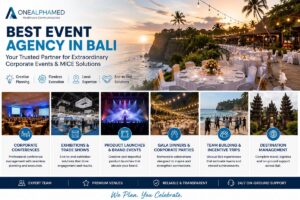
Best Event Agency in Bali: How to Choose the Right Partner for Your Next Event
Bali has become one of Asia’s busiest MICE and destination-event hubs — here’s the evaluation framework that separates a genuinely capable agency from a pretty portfolio site.
Executive Summary (TL;DR)
The Opportunity: Bali has cemented itself as one of Asia's leading destinations for meetings, incentives, conferences, exhibitions, and brand activations, with sustainability, wellness integration, and hybrid-ready formats now standard expectations rather than add-ons.
The Risk: Bali's event industry is fragmented across hundreds of small operators, villa-based planners, and freelance coordinators. Many can produce a beautiful photo gallery; far fewer can navigate the island's permitting, road-closure logistics, and vendor reliability at scale.
The Selection Framework: The right agency is not the one with the most Instagram followers — it's the one that can prove local infrastructure knowledge, transparent vendor relationships, and a track record on events similar in size and complexity to yours.
OneAlphaMed Research Desk
Pharma & Life Sciences Practice • Brand Strategy Intelligence
Updated:May 12, 2026
7 min read
In this article:
- 1. Why Bali Has Become a Global Events Hub
- 3. Corporate Events vs. Conferences vs. Brand Activations
- 5. Questions to Ask Before Hiring
Search “best event agency in Bali” and you’ll get hundreds of results — villa planners, MICE specialists, AV production houses, and freelancers all competing for the same query. Almost all of them look capable on the surface: strong photography, glowing testimonials, a tidy services page. The differentiation only shows up once you ask harder questions about permits, vendor networks, and what happens when something goes wrong two days before the event.
This guide breaks down what actually separates a strong Bali event partner from one that will leave you managing the crisis yourself, and how to evaluate agencies against your specific event type rather than a generic “best of” list.
1. Why Bali Has Become a Global Events Hub
Bali’s position as a top-tier event destination isn’t accidental. A combination of infrastructure, cost efficiency, and cultural depth has made it a default shortlist option for corporate incentive trips, international conferences, and large-scale brand activations alike.
The island continues to strengthen its position as one of Asia’s leading destinations for meetings, incentives, conferences, exhibitions, corporate gatherings, and brand activations, and the way events are designed and delivered is shifting fast. Sustainability has moved from a nice-to-have to a core expectation from attendees, sponsors, and corporate stakeholders, and organizers are increasingly using AI tools to improve efficiency and personalization across the event lifecycle. At the same time, wellness experiences are being integrated directly into corporate programs and conferences, reflecting how much attendee expectations have evolved beyond a standard conference-room format.
For planners, this means the agency you choose needs to be current on more than logistics — they need to understand what a 2026-standard event in Bali actually looks like.
2. What “Best” Actually Means When Choosing an Agency
The most common mistake in agency selection is treating “best” as a popularity contest — most reviews, biggest follower count, flashiest reel. None of that predicts whether your event runs on time.
Local infrastructure knowledge, not just local presence. The critical factor is choosing a local team Bali trusts to execute a professional rundown within the island’s complex infrastructure — a strong agency anticipates road closures, secures the right permits, and screens vendors for reliability before problems reach you.
Specialization over generalism. An agency built for intimate brand dinners is not automatically equipped for a 300-delegate conference with simultaneous AV feeds. Match the agency’s core specialty to your event type.
Vendor transparency. Ask directly who owns the vendor relationships — the agency, or a subcontracted network they don’t fully control. Agencies with vendors cherry-picked over a decade or more of direct experience tend to have far tighter quality control than those assembling a network per project.
Key Insight
“The event that photographs beautifully and the event that runs on schedule are not the same test. Screen agencies on the second one — permits secured, vendors confirmed in writing, a named point of contact on-site — before you ever look at the portfolio.”
3. Corporate Events vs. Conferences vs. Brand Activations
Bali’s event agencies are not interchangeable across categories, and the best-fit partner changes depending on what you’re actually planning.
Corporate & MICE: Look for agencies with dedicated corporate event planning experience — IATA-accredited group travel handling, end-to-end venue sourcing, delegate management, and 24/7 on-site assistance are the baseline for a conference or incentive trip, not a premium add-on.
Conferences & incentive trips: Multi-day, delegate-heavy programs need a producer fluent in Bali’s venue permitting and logistics for large international guest counts — not every general event planner takes these on, so confirm this is core to their business rather than an occasional side project.
Brand activations & product launches: These need production-heavy capability — staging, AV, and immersive design — alongside the standard logistics stack, since the “event” itself is the brand experience.
4. Red Flags to Screen Out Before You Sign
Certain warning signs show up consistently among agencies that look strong on paper but underdeliver operationally:
No named local team lead. If nobody can name the on-the-ground coordinator who will be physically present at your event, that’s a subcontracting risk.
Vague permit language. “We’ll handle permits” without specifying which permits, timelines, or who absorbs the cost of delays is a common gap that surfaces close to the event date.
Portfolio without process. A gallery of finished events tells you nothing about the planning cadence, communication frequency, or contingency planning that got them there. Ask for a sample project timeline, not just final photos.
→ India's pharmaceutical sector directed ₹3,328 crore toward digital media in 2025, with digital now accounting for 67% of total pharma advertising spend. For pharma brands, choosing a communication agency is no longer just about PR or media relations, it's about finding a partner that can navigate digital engagement, scientific content, regulatory compliance, and omnichannel communication.
5. Questions to Ask Before Hiring
Before signing with any agency claiming to be the best event agency in Bali for your event, get direct answers to:
How many events of this scale and type have you run in the last 12 months?
Who is our single point of contact, and are they on-site for the full event, not just setup?
Which vendors are yours directly, and which are subcontracted?
What’s your contingency plan for weather, vendor no-shows, or permit delays?
Can you share a reference client from an event similar in size to ours?
The Strategic Conclusion
Bali’s event industry has matured well past the point where a good photographer and a scenic villa were enough to call an event a success. As the island continues strengthening its position as a globally competitive MICE and events destination through infrastructure investment and industry collaboration, the agencies capable of matching that standard are the ones investing in permitting expertise, vendor accountability, and specialization — not just marketing.
The best event agency in Bali for your specific event is the one that can answer the operational questions above with specifics, not reassurance. Screen for that before the portfolio, and the rest of the decision gets much easier.
- Common Questions
Frequently Asked Questions
A: Prioritize local infrastructure knowledge — permit handling, vendor accountability, and road-closure awareness — over portfolio aesthetics alone. Confirm the agency specializes in your specific event type (corporate, conference, or brand activation), since these require different vendor networks and planning cadences.
A: For corporate events and conferences, 4–6 months ahead is standard to secure venues and permits. Larger delegate programs and multi-city incentive trips, especially in peak season (April–October), often need 8–12 months of lead time given venue and vendor demand.
A: Established agencies typically manage venue permits, vendor coordination, and on-the-ground logistics on behalf of overseas clients, but the scope varies significantly by agency — always confirm exactly which permits and approvals are included in the contract versus billed separately.
A: Yes, though capability varies widely. Agencies with dedicated MICE experience, IATA accreditation for group travel, and a track record of delegate-scale events are better suited to large conferences than boutique or villa-based generalists.
A: At minimum: closed-loop marketing (CLM) and e-detailing, medical education and CME design, KOL identification and engagement, scientific and medical writing, congress and symposia strategy, HCP digital communication (email, remote detailing, webinars), and pharma brand strategy. Agencies that offer only a subset of these are specialists in one area - useful for specific projects but not as a full communication partner.
A: Retainer-based partnerships with specialist pharma communication agencies in India typically range from ₹5 to ₹30 lakhs per month depending on scope, therapeutic areas covered, number of brands, and the breadth of services. Project-based engagements - a single CLM module, a CME program, a congress strategy - are priced separately. Agencies that are significantly below this range are almost certainly using junior or freelance resources and outsourcing core capabilities.
Share on:




Contact Us
+91 9811660635
info@onealphamed.com
2414, Ground Floor, Aravali Vihar, Sector 49 Faridabad, Haryana – 121001 India
Copyright © 2026 OneAlphaMed. All Rights Reserved.