Most pharma brands treat medical communications as the function that explains the brand strategy to doctors. The brands that outperform treat medical communications as part of how the strategy gets made in the first place.
Executive Summary (TL;DR)
The Problem: Brand strategy gets built in a boardroom - positioning, segmentation, messaging - and medical communications gets briefed afterward to "communicate it." But medical communications teams sit closest to how HCPs actually receive and judge clinical claims. Built in isolation, brand strategy arrives at the prescriber sounding like marketing wrote it without medical input - because it did.
The Strategy: Medical communications should be a strategic input, not a downstream output. It shapes which clinical claims will hold up under HCP scrutiny, which evidence sequence will actually build trust, and which messages a specialist will accept versus quietly dismiss. Brought in during strategy formation, not after, it becomes the credibility layer the rest of the strategy depends on.
The Imperative: Brands that separate "strategy" from "medical communications" end up with two versions of the same brand - one that sounds confident in the boardroom, and one that a prescriber actually believes. Closing that gap is not a content problem. It is a strategy design problem, and it starts with where medical communications sits in the process.
Pharma & Life Sciences Practice • Brand Strategy Intelligence
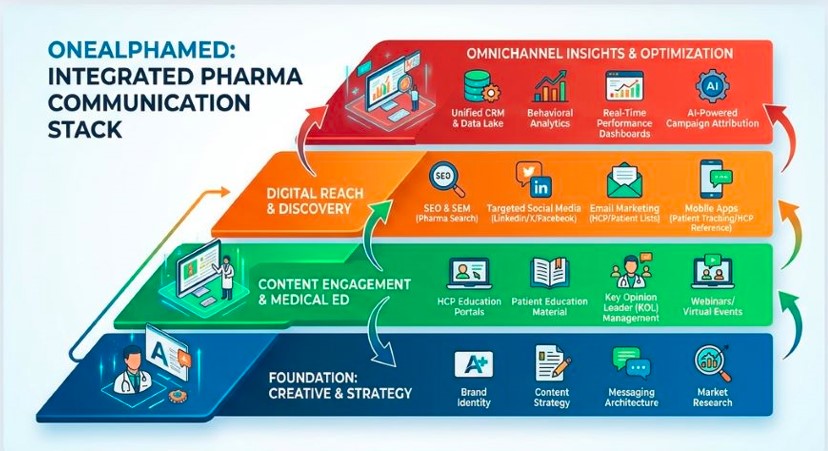
Fig 1. pharma communication-stack-diagram
Ask someone outside the industry what medical communications is, and if they have any idea at all, they will say “medical writing” – manuscripts, slide decks, scientific content. That answer is not wrong. It is just radically incomplete, and the incompleteness is exactly why medical communications gets sidelined in brand strategy conversations.
Medical writing is one output of medical communications. It is not the function itself. The function is broader: it is the discipline responsible for ensuring that everything a pharma company says about a product – to doctors, to regulators, to payers, to KOLs, to its own field force – is scientifically accurate, evidentially supported, and communicated in a way that the audience will actually trust.
That last part – trust – is the piece that gets lost when medical communications is treated as a writing service rather than a strategic function.
Within medical communications, three functions typically operate side by side. Medical education covers CME programs, scientific symposia, and content designed to build clinical understanding independent of brand promotion. Medical affairs covers KOL engagement, advisory boards, and the ongoing scientific dialogue between a company and the medical community – including how new data gets disseminated after launch. Commercial communication covers the brand-facing content: HCP detailing materials, CLM modules, congress presence, and promotional communication that must remain compliant with OPPI and similar codes.
These three functions are often organised as separate teams, sometimes reporting into entirely different parts of the organisation. Medical affairs may sit close to R&D. Commercial communication sits close to marketing. Medical education sits somewhere in between, depending on the company.
This organisational separation is sensible for governance – it keeps promotional and non-promotional activity appropriately distinct. But it has a side effect: brand strategy, which is owned by the commercial side, often gets built without meaningful input from the medical affairs and medical education functions that understand, better than anyone, how the target prescriber audience actually thinks.
“Post-approval (Phase 4) costs account for an estimated 23.7% of the total mean cost of drug development (95% CI: 17.7%–47.7%), according to a 2024 analysis of US drug development costs published in JAMA Network Open ”
In most pharma organisations, the brand strategy process looks something like this. The brand team – often supported by a strategy consultancy or brand agency – develops the positioning, segments the prescriber audience, defines the core message, and builds the launch plan. Once this is largely finalised, medical communications is brought in. Their brief: take this strategy and turn it into content. Write the detail aids. Build the CLM module. Develop the CME curriculum that supports the narrative.
This is the sequential model, and it is the default in most organisations not because anyone designed it that way, but because it mirrors the org chart. Strategy lives in commercial. Medical communications lives elsewhere. The natural path of least resistance is for strategy to be finished before it crosses that organisational boundary.
The problem with the sequential model is not that medical communications does a bad job of executing the strategy it receives. The problem is what the strategy itself is missing by the time it arrives.
A positioning statement developed without medical communications input has not been stress-tested against how a specialist will actually receive the claim. An evidence hierarchy developed without medical affairs input has not been checked against what KOLs in that therapeutic area are already saying – which may directly support the brand’s narrative, or may quietly contradict it. A prescriber segmentation built without medical education’s understanding of how that audience actually learns may target the right doctors with the wrong format entirely.
None of these gaps are visible in the strategy document. They become visible months later – in an HCP advisory board where a KOL questions the framing the brand has built its entire campaign around, or in field feedback where MRs report that the core message “doesn’t land” with specialists, without anyone being able to articulate exactly why.
By the time these signals surface, the campaign is already in market. Course-correcting a live campaign is possible, but it costs momentum, budget, and – most importantly – the first impression with the prescriber audience that a brand only gets once.
→ In a cross-sectional analysis of 110 novel drugs and biologics approved by the FDA (2009–2012), only 48.3% of completed postmarketing commitment trials were ever published in a peer-reviewed journal.
A positioning statement is, at its core, a claim – a specific assertion about what the brand offers that a prescriber should believe and act on. The strength of that claim depends entirely on how well it survives contact with a clinically sophisticated audience.
Medical communications professionals – particularly those with medical writing and medical affairs backgrounds – are trained to do exactly this kind of stress-testing. They ask the questions a specialist will ask: what is this claim based on, how does it compare to the existing standard of care, what happens to this claim if a competitor publishes new data next quarter, and where are the edges of what we can defensibly say.
When this stress-testing happens during strategy formation, weak claims get reworked before they become the foundation of a launch. When it happens after – during the medical-legal review of finished creative – the same weak claims often survive simply because reworking them at that stage means reworking everything built on top of them. The strategy ships with a soft foundation because fixing it has become too expensive.
Brand strategy typically defines what evidence supports the brand’s claims. It less often defines the sequence in which that evidence should be introduced to different audiences – and that sequencing is a medical communications discipline, not a marketing one.
A specialist encountering a new brand for the first time does not process information the way a marketing funnel assumes. They do not move neatly from “awareness” to “consideration” to “adoption.” They form an initial clinical impression based on the first piece of evidence they encounter – often informally, through a colleague, a congress poster, or a passing reference in a journal – and every subsequent piece of information is filtered through that initial impression.
Medical communications input into brand strategy means deciding, deliberately, what that first impression should be built on – and ensuring the brand’s own channels are positioned to be among the first sources a target prescriber encounters, rather than competing with whatever reaches them first by accident.
Every therapeutic area has a small number of clinical voices whose opinions carry disproportionate weight with their peers. A brand strategy that aligns with what these voices are already saying gains credibility quickly. A brand strategy that contradicts them – even unintentionally, even on a secondary point – faces quiet resistance that is very difficult to trace back to its source.
Medical affairs teams typically know who these voices are, what they have published, what they have said at recent congresses, and where their views sit relative to the brand’s intended positioning. This is strategic intelligence. When it is brought into brand strategy development early, it can shape positioning to align with – or thoughtfully address – the views that will most influence how the broader prescriber community receives the brand. When it surfaces only after the strategy is finalised, the best a brand can do is hope the KOLs do not notice the misalignment, or scramble to manage it after they do.
The shift from the sequential model to an integrated one does not require restructuring the organisation. It requires changing when medical communications gets involved – from after the strategy is written to while it is being written.
In practice, this looks like medical communications professionals being present in early positioning workshops – not to write anything yet, but to ask the questions a prescriber would ask. It looks like draft claims being reviewed by medical affairs for how they will be received by known KOLs in the therapeutic area, before those claims are locked into a creative brief. It looks like evidence sequencing being treated as a strategic decision, discussed alongside segmentation and channel strategy, rather than left for the medical writing team to figure out once the campaign brief arrives.
None of this slows the process down in any meaningful way – brand strategy development typically spans weeks regardless. What it does is ensure that by the time the strategy is finalised, it has already survived the kind of scrutiny it will face in the market – rather than discovering that scrutiny for the first time when it is much more expensive to respond to.
For pharma companies building brand strategy ahead of a launch, the practical question is not “should medical communications be involved” – most organisations would agree they should be. The real question is when. And the evidence, consistently, points to earlier than most organisations currently default to.
A: Medical communications is the discipline responsible for ensuring that everything a pharma company communicates about a product - to healthcare professionals, regulators, payers, and KOLs - is scientifically accurate, evidence-based, and communicated in a way the audience will trust. It typically spans three functions: medical education (CME, scientific symposia), medical affairs (KOL engagement, advisory boards, data dissemination), and commercial communication (HCP detailing, CLM, congress materials).
A: Marketing focuses on positioning, channel strategy, and campaign execution to drive brand awareness and adoption. Medical communications focuses on the scientific accuracy, evidence base, and credibility of what is being communicated - and on how that information will be received by a clinically sophisticated audience. The two are not competing functions; the strongest pharma brand strategies integrate both from the start rather than treating medical communications as a downstream check on marketing's output.
A: HCPs form impressions of a brand based on the accumulated credibility of everything they encounter about it - detailing materials, CME content, KOL commentary, and congress presence. Medical communications shapes the scientific rigour and evidence basis of all of these touchpoints. When medical communications is involved early in brand strategy, these touchpoints are consistent and clinically defensible from launch. When it is involved late, inconsistencies between what the brand claims and what HCPs already believe can quietly undermine trust before the brand team is even aware there is a gap.
+91 9811660635
info@onealphamed.com
2414, Ground Floor, Aravali Vihar, Sector 49 Faridabad, Haryana – 121001 India
Copyright © 2026 OneAlphaMed. All Rights Reserved.