Most pharma brands in India are not working with a pharma communication agency. They are working with a healthcare marketing agency that accepted a pharma brief and the difference is costing them prescriber relationships they did not even know they were losing.
Executive Summary (TL;DR)
The Problem: Most agencies calling themselves pharma specialists have never built a CLM module, cannot name an OPPI guideline without looking it up, and have no in-house medical writers. Brands find this out 8 months into the retainer.
The Strategy: A pharma communication agency must pass three filters before the pitch deck matters: regulatory literacy (OPPI, DCGI, NMC), HCP communication depth (CLM, e-detailing, omnichannel), and in-house medical writing capability. Everything else is secondary.
The Imperative: The wrong agency does not just waste budget. It puts non-compliant materials in the hands of your field force, weakens the MR-doctor interaction, and erodes prescriber credibility that takes years to rebuild - if it can be rebuilt at all.
Pharma & Life Sciences Practice • Brand Strategy Intelligence
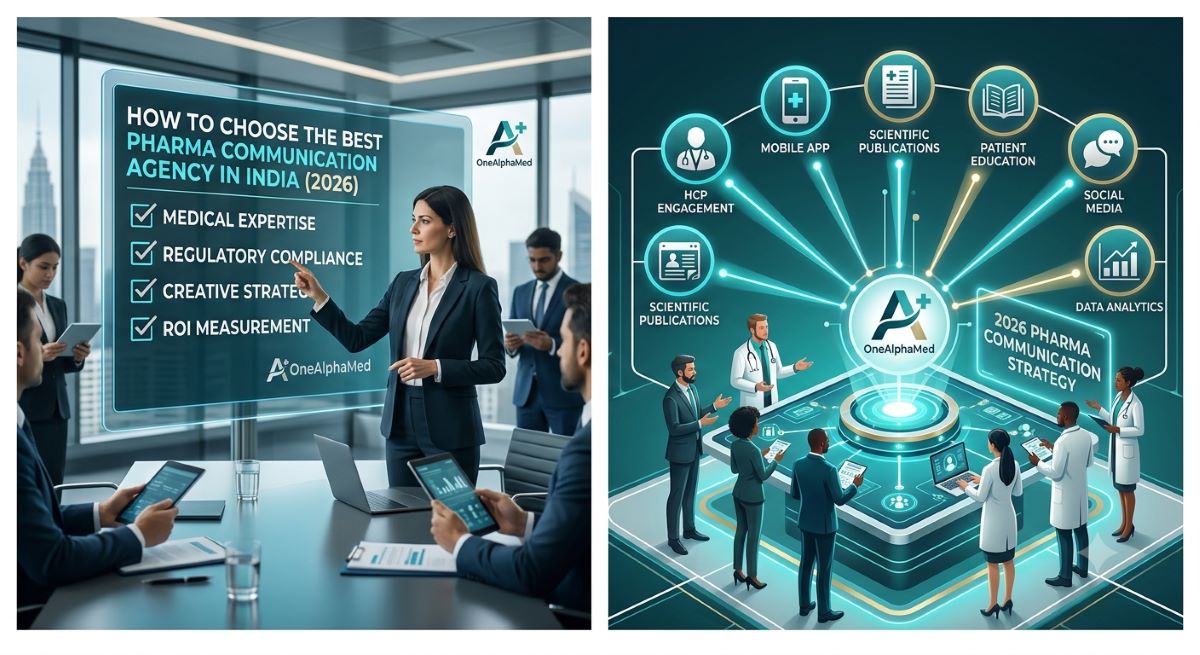
Fig 1.
How to Choose the Best Pharma Communication Agency in India (2026)
There is a version of this decision that plays out in pharma marketing teams across India every year: the RFP goes out, six agencies walk in, five of them are excellent at showing beautiful slides, and one of them actually understands what closed-loop marketing does to HCP engagement at the district level. The brand team picks one of the five. Then spends the next eight months trying to explain what a CLM module is.
Choosing the wrong pharma communication agency is not just expensive, it is a problem that compounds. Your field force is armed with the wrong story. Your KOLs receive materials that do not reflect current evidence. Your CME programs look like marketing events. And your brand, slowly, loses the trust of the very prescribers it was built to serve.
This guide is for pharma brand managers, medical affairs leads, and marketing heads who are done with generic checklists and want a clear-eyed framework for evaluating what the best pharma communication agencies actually look like.
“67% of pharmaceutical advertising spend in India is now allocated to digital media, up from 54% just a year earlier, signaling a rapid shift toward digital-first healthcare communication.”
Before you open a single agency deck, you need to get precise about the type of agency you need. This is the step most pharma teams skip and it is why so many agency relationships fail.
These two categories are often conflated, including by the agencies themselves. But the differences are significant.
A healthcare marketing agency is built to communicate with patients and the general public. Their strongest capabilities are typically consumer digital social media, health content, OPD appointment campaigns, hospital branding. They understand patient journeys, conversion funnels, and awareness campaigns. For a hospital, a diagnostic chain, or a consumer health brand, they are the right choice.
A pharma communication agency is built to communicate with healthcare professionals – doctors, specialists, pharmacists, and medical institutions. Their strongest capabilities are scientific communication, HCP engagement, medical education, field force enablement, and regulatory-compliant brand strategy. They understand prescribing behaviour, therapeutic area nuance, and the difference between what a cardiologist needs to know and what a general physician needs to know. For a pharma brand, they are the right choice.
Hiring a healthcare marketing agency to do pharma communication is like asking a brilliant copywriter to write a clinical trial protocol. The intent is right; the expertise is not.
When we talk about pharma communication in the Indian context, we are talking about four interconnected disciplines:
HCP communication – how your brand speaks to prescribers across every channel
Medical education – how you build credible clinical narratives that earn prescriber trust
Scientific communication – how your data, evidence, and publications are translated for medical audiences
Brand strategy – how your brand is positioned in a competitive therapeutic landscape, compliantly
The best pharma communication agency is not just strong in one of these — it holds all four together as a coherent whole.
India is the world’s third largest pharmaceutical market by volume. It is also one of the most complex regulatory environments for pharma communication. Understanding this complexity is not optional – it is the baseline requirement for any agency you trust with your brand.
The Organisation of Pharmaceutical Producers of India (OPPI) Code of Conduct governs how pharmaceutical companies may communicate with healthcare professionals. It covers gifts, hospitality, sponsorships, promotional materials, samples, and scientific meetings and any agency that cannot speak fluently about these guidelines has no business near your brand.
The Drugs and Cosmetics Act and DCGI regulations govern what can be claimed about a drug in promotional materials. Schedule H and Schedule X drugs have specific restrictions on how, where, and to whom they can be promoted. A pharma communication agency operating in India must have regulatory affairs literacy built into its creative process – not bolted on as a compliance review at the end.
If you ask an agency about the OPPI Code in your first meeting and they reach for their phone to check what it is, end the meeting politely and do not call back.
In the Indian pharma market, the prescriber relationship is still the primary commercial driver. A brand that earns genuine clinical credibility – through evidence-backed communication, credible medical education, and respectful HCP engagement – builds durable prescriber preference that survives price competition and generic pressure.
A pharma communication agency that understands this does not think in campaigns. It thinks in relationships – how to build clinical trust over time, how to support the field force with the right message at the right moment in the prescriber’s clinical journey, and how to ensure that every touchpoint reinforces scientific credibility rather than simply commercial interest.
→ India's pharmaceutical sector directed ₹3,328 crore toward digital media in 2025, with digital now accounting for 67% of total pharma advertising spend. For pharma brands, choosing a communication agency is no longer just about PR or media relations—it's about finding a partner that can navigate digital engagement, scientific content, regulatory compliance, and omnichannel communication.
HCP communication is the central discipline of a specialist pharma agency. It covers closed-loop marketing (CLM) and e-detailing – the digital tools that enable field medical representatives to deliver personalised, interactive brand stories to doctors rather than static visual aids. It covers email and digital outreach to HCPs, remote detailing, and omnichannel sequencing that coordinates across in-person and digital channels.
The best agencies build CLM modules that actually change what happens in the 90-second doctor-MR interaction. That is a very specific skill – part scientific storytelling, part UX design, part field force psychology and most agencies do not have it.
Continuing Medical Education (CME) is one of the most powerful and most misused tools in pharma communication. When done well, a CME program positions your brand as the scientific home of a therapeutic area – a genuine educational partner to the specialist community. When done poorly, it looks like a veiled promotional event, erodes trust, and may draw regulatory scrutiny.
The best pharma communication agencies design CME programs that would be credible even if your brand was not sponsoring them. The science drives the agenda. The independent faculty drives the content. The brand benefits from the association, not from a product pitch.
Key Opinion Leader (KOL) management is about identifying the right clinical voices in your therapeutic area – the specialists whose peer credibility, publication record, and clinical standing make them trusted sources of guidance for other prescribers and building genuine, long-term relationships with them on behalf of your brand.
A capable pharma communication agency maintains KOL databases by therapeutic area and geography, understands the difference between a national KOL and a regional influencer, and knows how to engage KOLs ethically within the OPPI framework. This is not influencer marketing. It is scientific relationship management.
Medical writing is where many pharma communication agencies quietly fail. You will not discover this from a credentials deck – you will discover it when the first manuscript your brand submits for publication is returned with editorial corrections that suggest it was written by someone without clinical training.
The best pharma communication agencies employ trained medical writers – people with degrees in life sciences, pharmacy, or medicine – who can produce clinical manuscripts, review articles, monographs, slide decks for medical meetings, and prescriber training materials to a standard that withstands peer review. Ask to see published work. Ask whether their medical writers are in-house or freelance. Ask what their quality review process is.
Medical conferences, both national and international are the highest-visibility moments in a brand’s clinical calendar. A pre-congress strategy, a symposia design that attracts quality attendance, post-congress content that amplifies abstracts and trial data into the broader prescriber community – these are not event management tasks. They are strategic communication moments. The best pharma agencies plan for congress twelve months out and execute with the precision of a scientific publication, not a hospitality event.
Ask to see pharma work – not healthcare work broadly. Ask specifically for examples of CLM modules, CME program designs, scientific slide decks, HCP email campaigns, and KOL engagement programs. An agency that shows you hospital social media posts and patient awareness campaigns when you ask for pharma communication experience is telling you something important.
Every senior person in the agency who will work on your brand should be able to discuss the OPPI Code without referring to notes. They should know the rules around gifts, sponsorships, and hospitality. They should know what a fair market value assessment is and why it matters. They should know the NMC (National Medical Commission) guidelines on pharma-doctor interactions. Regulatory literacy is not the compliance department’s job – it is the creative team’s job.
In-house is better. Agencies that outsource medical writing have a quality control problem – the writer who produces your content has no investment in your brand, no institutional knowledge of your portfolio, and no accountability beyond the word count. Ask who will write your materials, what their qualifications are, and whether you can speak to them directly.
The modern HCP communication stack includes CLM, e-detailing, remote detailing, WhatsApp business communication for medical updates, webinar platforms optimised for HCP audiences, and precision email sequencing. Ask which of these the agency has built campaigns on. Ask for engagement data from real campaigns – open rates, module interaction rates, conversion from awareness to prescription inquiry. Generic digital metrics do not tell you anything useful.
A pharma communication agency working in oncology should understand tumour staging, treatment protocols, biomarker testing, and the clinical decision journey of an oncologist. An agency working in cardiology should understand the prescribing hierarchy – who initiates, who continues, who switches. You do not need an agency that has only ever worked in your specific therapeutic area, but you do need one that learns your area quickly and demonstrates depth, not surface familiarity.
Reach is the vanity metric of pharma communication. What you need to know is whether the right doctors received the right message and whether it changed their clinical consideration of your brand. The best agencies report on HCP-level engagement – which segments responded, which messages resonated, where prescribers dropped off in a CLM module, and how communication activity correlates with prescribing data over time.
[IMAGE: pharma-agency-red-flags.jpg]
A pharma communication agency specialises in communicating with healthcare professionals - doctors, specialists, and pharmacists - on behalf of pharmaceutical brands. Core services include HCP communication (CLM, e-detailing), medical education and CME programs, KOL management, scientific and medical writing, and congress communication. Unlike a general healthcare marketing agency, a pharma communication agency is built around regulatory compliance, scientific credibility, and prescriber engagement.
A: A healthcare marketing agency focuses primarily on patient-facing communication - hospital branding, patient acquisition, consumer health content. A pharma communication agency focuses on HCP-facing communication - reaching and engaging doctors, specialists, and pharmacists with scientifically credible, OPPI-compliant brand messaging. Pharma brands need the latter; many mistakenly hire the former.
A: Evaluate them on six criteria: a pharma-specific portfolio (not just healthcare), demonstrated regulatory literacy (OPPI, DCGI, NMC), in-house medical writing capability, HCP channel expertise beyond email and events, therapeutic area depth, and reporting that measures prescriber engagement rather than just reach.
A: OPPI stands for Organisation of Pharmaceutical Producers of India. The OPPI Code of Conduct governs how pharmaceutical companies communicate with and engage healthcare professionals - covering promotional materials, gifts, hospitality, sponsorships, samples, and scientific events. A pharma communication agency operating in India must design all campaigns and materials within OPPI guidelines to protect both the brand and the company.
A: At minimum: closed-loop marketing (CLM) and e-detailing, medical education and CME design, KOL identification and engagement, scientific and medical writing, congress and symposia strategy, HCP digital communication (email, remote detailing, webinars), and pharma brand strategy. Agencies that offer only a subset of these are specialists in one area - useful for specific projects but not as a full communication partner.
A: Retainer-based partnerships with specialist pharma communication agencies in India typically range from ₹5 to ₹30 lakhs per month depending on scope, therapeutic areas covered, number of brands, and the breadth of services. Project-based engagements - a single CLM module, a CME program, a congress strategy - are priced separately. Agencies that are significantly below this range are almost certainly using junior or freelance resources and outsourcing core capabilities.
+91 9811660635
info@onealphamed.com
2414, Ground Floor, Aravali Vihar, Sector 49 Faridabad, Haryana – 121001 India
Copyright © 2026 OneAlphaMed. All Rights Reserved.