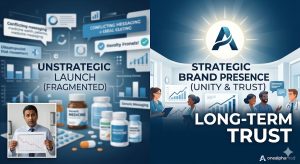
Most pharma launches underperform not because the clinical data is weak — but because there is no coherent brand strategy underneath the spend.
By OneAlphaMed Editorial Team
Executive Summary (TL;DR)
The Problem: Clinical approval is necessary. It is not sufficient. According to Deloitte, 41% of pharma launch failures are caused by poor product differentiation and 47% by inadequate understanding of market needs, both brand strategy failures, not clinical ones.
The Strategy: A pharmaceutical brand strategy must answer three queries before launch: what the brand clinically represents, who is the target audience, and why they believe it. Everything else will fall into positioning, HCP.engagement, payer narrative, patient support - flows from those three answers.
The Imperative: The brands that build brand strategy into their Phase 3 planning arrive at approval ready to launch. The ones that build it after approval arrive at launch permanently catching up.
Pharma & Life Sciences Practice • Brand Strategy Intelligence

Fig 1.
Pharma Brand Strategy Matters for Pharmaceutical
Pharmaceutical companies spend more on drug development than almost any industry on earth. The average cost of bringing a single drug to market now exceeds $2.8 billion. And yet a significant proportion of those launches underperform their commercial forecasts – not because the science failed, but because the brand strategy did not exist.
That is not a clinical problem. It is a strategy problem. And it is more common than the industry is comfortable admitting.
Deloitte analysed drug launches between 2012 and 2021 and found that more than a third missed their launch forecasts. Of those failures, 57% were attributed to limited market access, 47% to inadequate understanding of market and customer needs, and 41% to poor product differentiation.
Read those again. Not clinical failure. Not manufacturing issues. Not safety problems. Market access, market understanding, and product differentiation – all three of which are pharmaceutical brand strategy failures dressed up as commercial ones.
The therapy worked. The brand did not.
“Clinical approval opens the door. Pharmaceutical brand strategy determines whether anyone walks through it.”
Let’s clear something up first. A pharmaceutical brand strategy is not a logo refresh. It is not a new tagline or a visual identity overhaul. Those things might come out of it eventually – but they are not it.
A pharmaceutical brand strategy answers three questions before any commercial activity begins. What does this therapy stand for clinically – what is the specific, defensible position it holds in its market? Who actually needs to hear that story – which prescribers, which payers, which patients, in what order? And why should they believe it – what evidence gives this brand the right to claim that position?
Everything else in pharma brand management flows from those three answers. The HCP engagement model, the payer access strategy, the patient support programme, the congress presence, the publication plan – all of it is the execution of those answers. When the answers are clear, the execution is coherent. When they are not, every function runs a slightly different version of the brand story. And the prescriber who interacts with all of them walks away confused.
This is where most pharmaceutical companies make the mistake that costs them at launch.
Strong clinical data is necessary. A therapy that does not work does not need a brand strategy – it needs a different molecule. But clinical data is not, by itself, a brand strategy. It is the raw material from which a brand strategy is built.
The gap between clinical data and a pharmaceutical brand strategy is the gap between what is true about the therapy and what is meaningful to the people who need to act on it. A payer committee does not read a clinical trial the same way a prescribing oncologist does. A patient looking forward to starting a new therapy will not evaluate it the way a formulary pharmacist does.That is the real job of a pharmaceutical brand strategy. Not to make the science sound better than it is – but to make sure the people who need to act on it can actually understand why it matters to them. A payer committee and a prescribing oncologist are looking at the same therapy. They are not asking the same question. The brand strategy is what ensures both get an answer that makes sense in their world.
That translation work is what pharma brand positioning does. And most companies either do it too late, do it inconsistently across functions, or do not do it at all.
What a Strong Pharmaceutical Brand Strategy Covers
A pharmaceutical brand strategy is not a single document. It is a connected framework that runs from Phase 3 planning through loss of exclusivity. Here is what it needs to cover.
Clinical Positioning
The question here is simple to ask and hard to answer honestly: what does this therapy do that nothing else in this space does – and for which patients does that actually matter?
Simple to ask because everyone has a version of an answer. Hard to answer honestly because the honest answer requires looking at the data, not the aspiration. A positioning that cannot be defended with clinical evidence will not survive a payer committee, a formulary review, or a sceptical KOL who has read the trial. If the positioning is not grounded in what the data actually shows, it is not a position – it is a wish.
Audience Prioritisation
Pharma brand management asks you to speak to multiple audiences at the same time – specialist physicians, primary care prescribers, formulary committees, patient advocacy groups, patients themselves. Each of them is evaluating the same therapy through a completely different lens.
The mistake is treating that as a communications problem – writing different versions of the same brochure. The brand strategy question is harder: who comes first, who gets which evidence, and in what sequence does the story need to be told for each audience to trust it? Not every audience gets the same message. But every audience should be hearing a version of the same underlying truth – adapted for how they make decisions, but never contradicting what you are saying to someone else.
The Payer Narrative
Market access is where pharmaceutical brand strategy meets financial reality. The payer narrative – the health economic argument for why this therapy deserves preferred formulary status – needs to be built from the same clinical foundation as the HCP story, but translated into the language of outcomes, cost-effectiveness, and population health. Brands that develop the payer narrative as an afterthought, after the commercial messaging is already set, consistently underperform on formulary access. Brands that build it in parallel consistently outperform.
The Patient Story
Healthcare brand strategy that ignores the patient is incomplete. Not because patient engagement is a regulatory requirement – though increasingly it is – but because patient adherence is a commercial outcome. A brand whose patients do not understand why they should stay on therapy, cannot afford to stay on therapy, or do not receive the support to navigate the therapy’s complexity, is a brand that loses commercial value every month post-launch. The patient story is not separate from the brand strategy. It is the downstream proof of whether the brand’s clinical promise was real.
The Launch Sequence
Pharma product launch strategy is the temporal dimension of brand strategy – deciding what happens first, what happens in parallel, and what happens in response to market feedback. A pharmaceutical brand strategy that does not include a launch sequence is a set of good ideas without a plan for executing them in the right order. Disease awareness before branded promotion. KOL engagement before congress presence. Payer dossier before formulary submission. The sequence matters as much as the strategy itself.
When to Build Your Pharmaceutical Brand Strategy
The answer to this is almost always earlier than you think.
The brands that arrive at regulatory approval with a complete pharmaceutical brand strategy – one that has already shaped the clinical trial design, informed the publication plan, built the KOL network, and prepared the payer dossier – launch faster, achieve formulary access sooner, and build prescriber trust more quickly than the brands that start the strategy work at approval.
Deloitte’s analysis of pharma launches found that companies engaging payers 18 to 24 months before launch consistently outperform those that begin that engagement post-approval. The same principle applies to the full brand strategy. The earlier the strategic foundation is built, the more commercial work it can do.
For a specialty or first-in-class launch, Phase 3 initiation is the right moment to begin building the pharmaceutical brand strategy. The competitive landscape is crystallising. The clinical data is taking shape. The patient population is becoming visible. The brand position that emerges from that data – rather than being retrofitted onto it – will be more defensible, more credible, and more commercially durable.
→ The best pharmaceutical brand strategies are not built at launch. They are built during Phase 3 and simply activated at launch.
A pharmaceutical brand strategy does not end at launch peak. Lifecycle management – new indication filings, line extensions, real-world evidence generation, and loss of exclusivity planning – requires a brand strategy that evolves with the product’s clinical and commercial position.
The brands that maintain market share through patent cliff are almost always the ones that began accumulating real-world evidence before the generics arrived. That evidence – how the branded therapy performs in actual clinical practice, across actual patient populations, over actual years of use – is something no generic manufacturer can replicate. It is the pharmaceutical brand’s most durable competitive asset, and it only exists if the brand strategy included a plan to generate it from launch onwards.
A: Pharmaceutical brand strategy is the framework that defines what a therapy stands for clinically, who the brand needs to reach, and why those audiences should believe it - before any commercial activity begins. It connects clinical differentiation to commercial outcomes across HCP engagement, payer access, patient support, and product launch planning. It is the foundation on which every other commercial decision sits.
A: Because clinical data and commercial success are not the same thing. A therapy that works but is poorly differentiated from what already exists, or whose value has not been communicated in a way payers can act on, or whose patient population has not been clearly defined - that therapy will underperform. Deloitte's analysis of launches over a decade found that poor product differentiation and inadequate understanding of market needs were among the leading causes of commercial failure. Neither of those is a clinical problem. Both of them are brand strategy problems.
A: Earlier than feels necessary at the time - which is almost always during Phase 3. Not at approval, when everyone is relieved the data read out well. Phase 3 is exactly when the competitive landscape is crystallising,and the clinical data is taking shape, and the target audience i.e. patient population is becoming visible. A brand position built from that data - rather than retrofitted onto it after approval - is more defensible and more commercially durable. The brands that arrive at approval with their strategy already built launch faster and access formulary sooner. The ones that start building at approval spend the first year of commercial life catching up.
A: Think of it this way. Brand strategy is the answer to "what are we?" Marketing strategy is the answer to "how do we say it?" One comes before the other - and the order matters. A pharma marketing strategy built without a clear brand strategy underneath it is just spend. You are in market, you are producing content, reps are detailing - but there is no coherent story holding it together. Flip it the other way and you have a beautifully defined position that never reaches the people it is meant for. Both matter. Brand strategy first.
A: More directly than most commercial teams realise - and usually later than it should. The case you make to a formulary committee is not a separate document from your brand strategy. It is the same clinical story, rewritten for an audience that does not care about mechanism of action and cares very much about cost per outcome. When that payer narrative is built from the same foundation as everything else, it is coherent and credible. When it gets commissioned six months before a formulary submission, it often contradicts what the commercial team has been saying to prescribers for a year. That inconsistency does not go unnoticed.
+91 9811660635
info@onealphamed.com
2414, Ground Floor, Aravali Vihar, Sector 49 Faridabad, Haryana – 121001 India
Copyright © 2026 OneAlphaMed. All Rights Reserved.